Grimm's Pier
Gallery
img
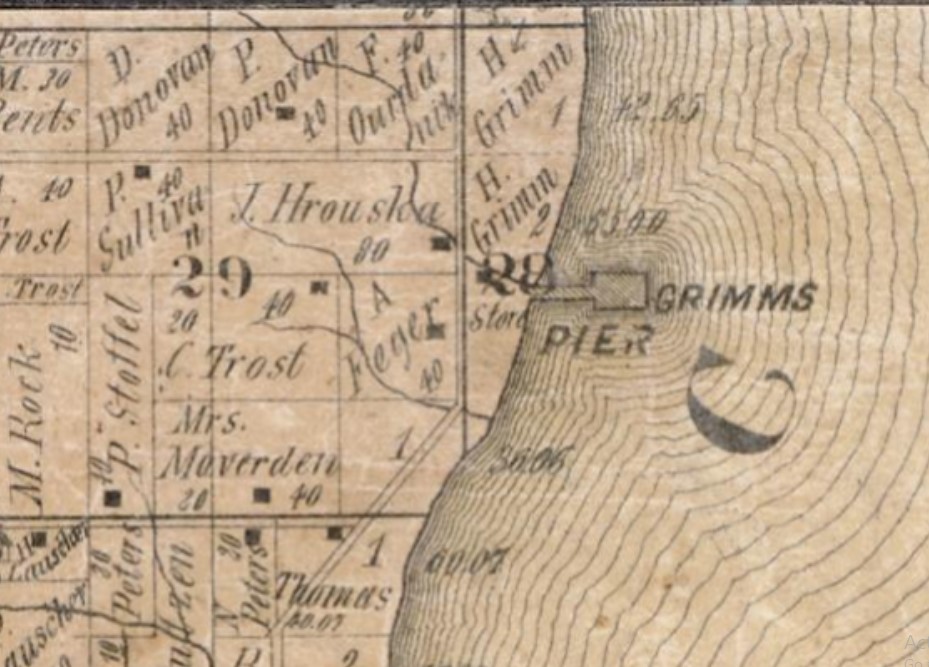
Grimm's Pier 1876
img
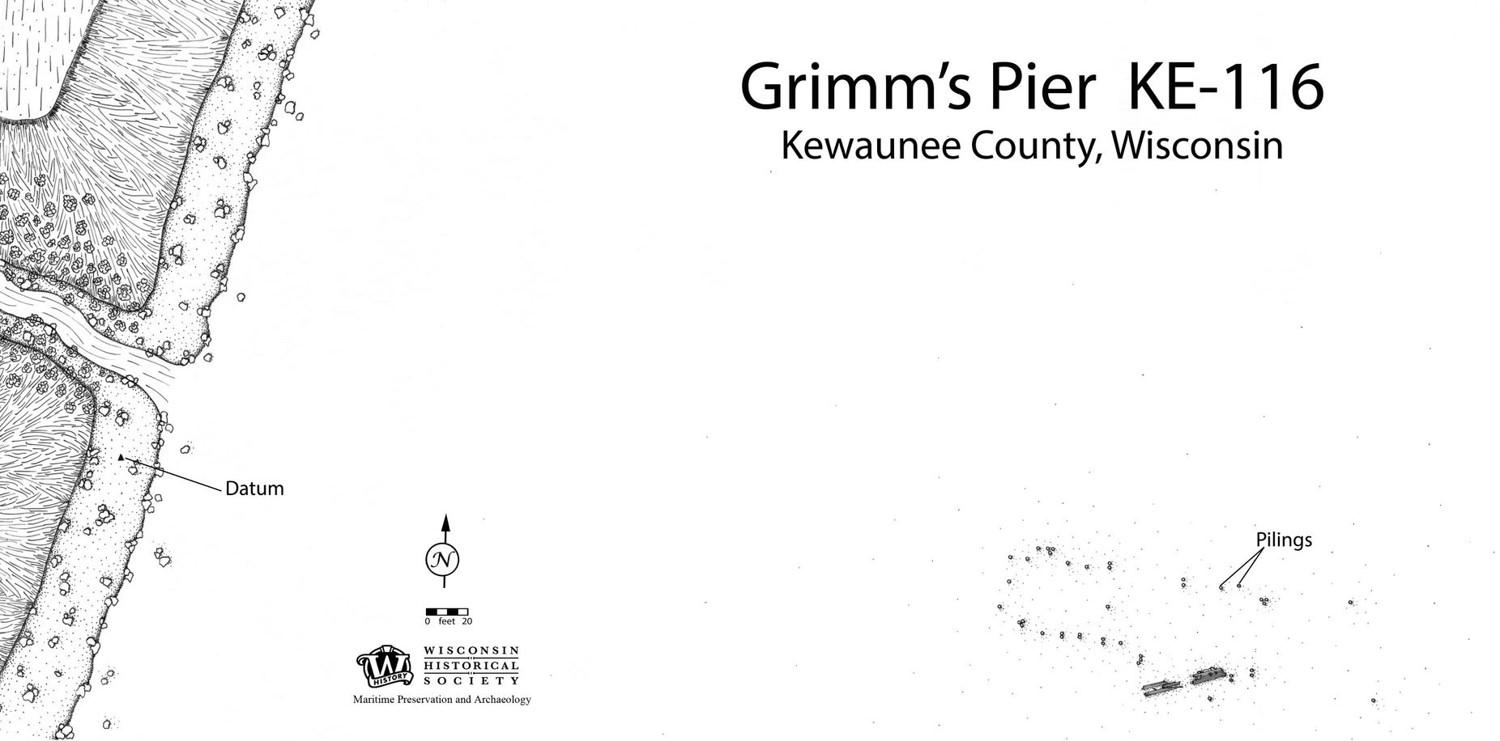
Site plan for Grimm's Pier
img
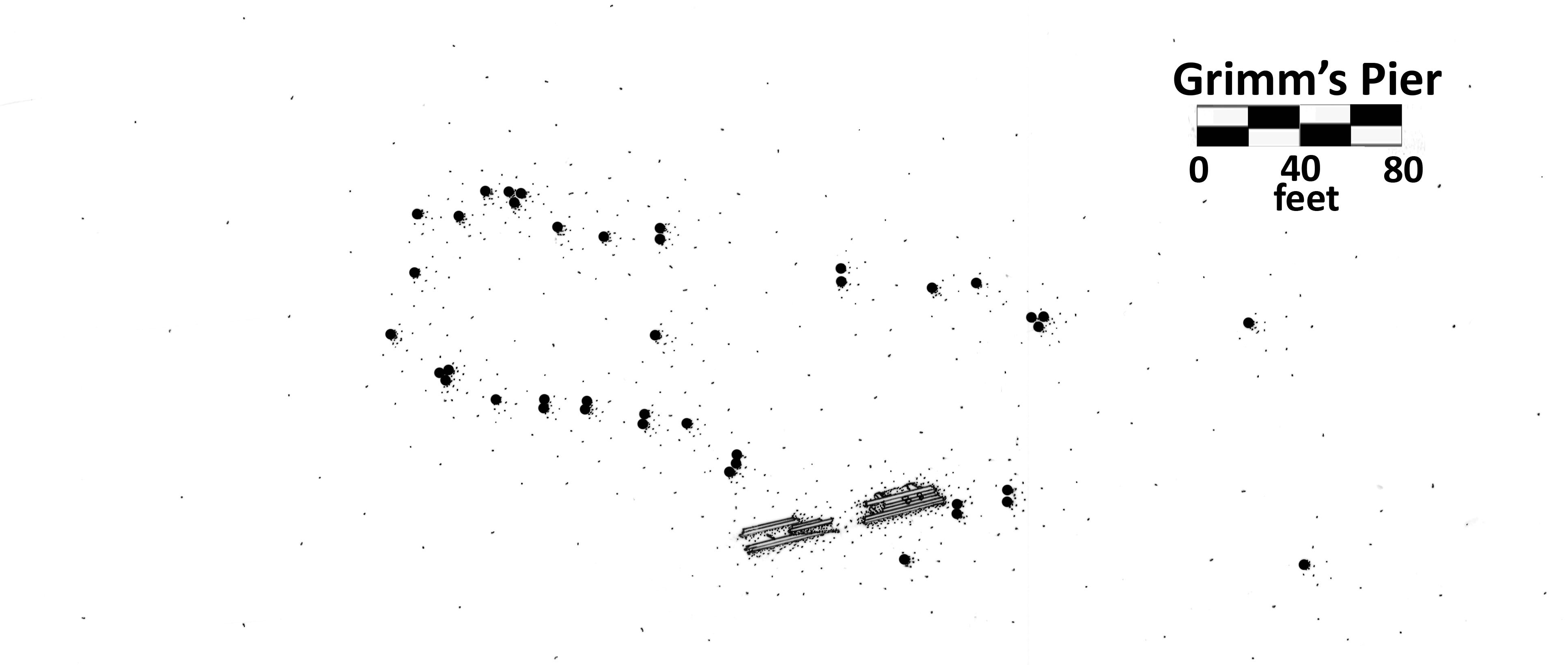
Detail of Grimm's Pier
 
Attraction
Description
Grimm’s Pier is located north of Kewaunee, where a small stream enters Lake Michigan. The pier was one of the lesser ‘ghost ports’ of the coast and only featured a general store and support buildings. The pier's poor location, in the midst of rocky shoals, made it a relatively hazardous place for schooners to pick up cargoes of timber goods. Numerous schooners struck rocks near the pier, and at least one (possibly two), sank near the pier and could not be refloated.

The pier and store were owned and presumably managed by Henry Grimm, a Prussian immigrant. The completed pier extended only 660 feet into the lake, providing little room to maneuver past the shoals to her south. An account written in early 1870 mentions that an unnamed vessel was lost at the pier in 1868. In April of 1869, a fore-and-after schooner picking up posts ran into one of the nearby boulders while leaving the pier but was able to get free after the deckload was thrown into the lake. In September, the schooner Rival arrived to pick up 50 cords of wood, and struck another boulder just after leaving the pier. The uninsured Rival was stripped and abandoned. Within a few more days, her broken wreck had been driven off the bottom by the waves, coming to rest on the beach near the pier. Grimm made the decision to extend the pier 400 feet further into the lake in late 1869, bringing it to a new length of 1,060 feet.

By September 1871, Grimm was doing a good business. His properties included his store and a farm where he grew and stockpiled hay and oats. He owned the usual set of farming tools, along with nine sleighs likely used to transport lumber. His workforce was sufficient to operate the pier, manage the store, work the farm, and cut and transport enough timber to extend the pier to its new length. His store yards were still well-stocked, even late in the season before the winter’s timber harvest could commence. The Peshtigo Fire struck late that month. Though the pier, store, and pier complex were saved, Grimm lost his barn, 20 tons of hay, 500 bushels of oats, his farming equipment, and his nine sleighs, along with wood products stockpiled at the pier: 8000 hops poles, 7000 railroad ties, 500 cedar posts, 460 cords of maple, 150 cords of beech, and 18 cords of tanning bark. Grimm was not insured, and his losses—in modern currency—were estimated at nearly $146,000. In the aftermath, Grimm’s Pier became a rallying point where survivors regrouped and sought lake transport away from the smoldering remains of their lives.

Within a month, the pier was shipping again. Grimm’s run of bad luck, however, continued. In October, the scow schooner Swallow arrived to pick up railroad ties but struck a rock and sank. The schooner was likely refloated afterwards. In late spring of 1873, an ice shove tore off 60 feet of the pier and dumped 90 cords of bark and wood stored on the pier into the lake. The scow schooner Hercules sank at or near the pier in 1876, but was saved by the tug Kitty Smoke.

Grimm got out of the pier business shortly afterwards, closed down the store, and became a farmer. In his later years, he moved to Algoma and embarked on a new and more profitable career in the hospitality business.

The remains of Grimm’s Pier lie on a heading of 106 degrees, and extend between 435 to 640 feet from the current beach. Given this distance from shore, it is likely that the preserved pilings represent the remains of the original 1867 pier rather than the 1869 addition or any rebuilding after the 1873 ice shove. It is very likely that more pilings exist closer to shore, but they are covered by sand and rocks. At least 41 pilings are present. They sit in eight to 12 feet of water, and all measure approximately one foot in diameter. The spacing of the pilings is irregular, but a general pattern can be seen. Similar to the other piers recorded in this region, the pier appears to have been supported by three rows of pilings extending out from shore. The outer rows of pilings largely consist of paired pilings or groups of three pilings set close together, while the inner row of pilings appears to consist of single pilings. The spacing of the pilings suggests that the width of the pier could not have been less than 44 feet, more than sufficient for draft teams and wagons to pass by one another, or for teams to maneuver on a pier laden with stockpiled timber goods.

Extending over 42.2 feet in length, a section of longitudinal wooden planking is located near the southernmost row of outer pilings, beginning approximately 516 feet from shore. This section of planking is made up of timbers measuring 0.7 feet wide and 0.3 feet thick. Additionally, what appear to be four pilings, cut to match the level of the timbers, are located between a few of the timbers. It is not precisely known what this section of timbers is, but it is likely that it is part of the pier’s wooden deck, or part of a building situated along the pier.
 
Map
 
Nearby
© 2026 - Wisconsin Sea Grant, Wisconsin Historical Society