
Foscoro / Fellows Pier
Gallery
img
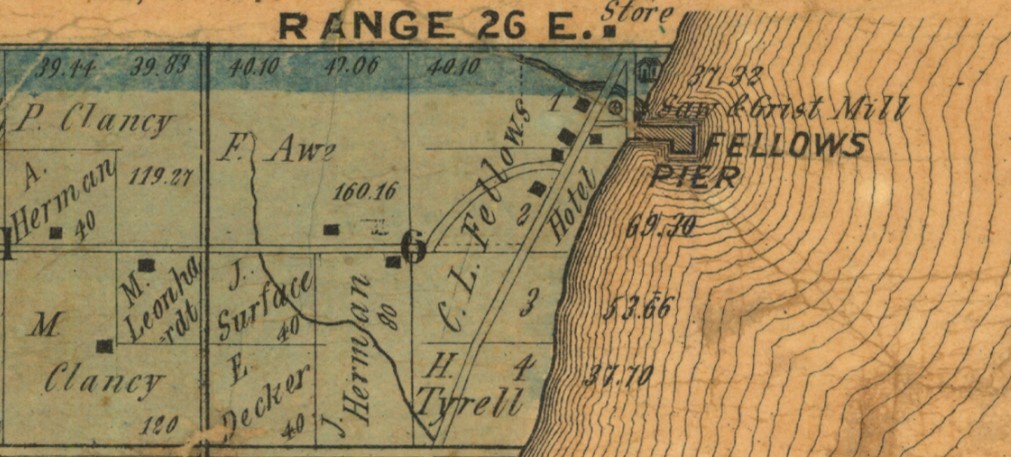
1876 Map of Foscoro Pier, Ahnapee Township, from "Map of Kewaunee County, Wisconsin" by E. M. Harney and M. G. Tucker
img
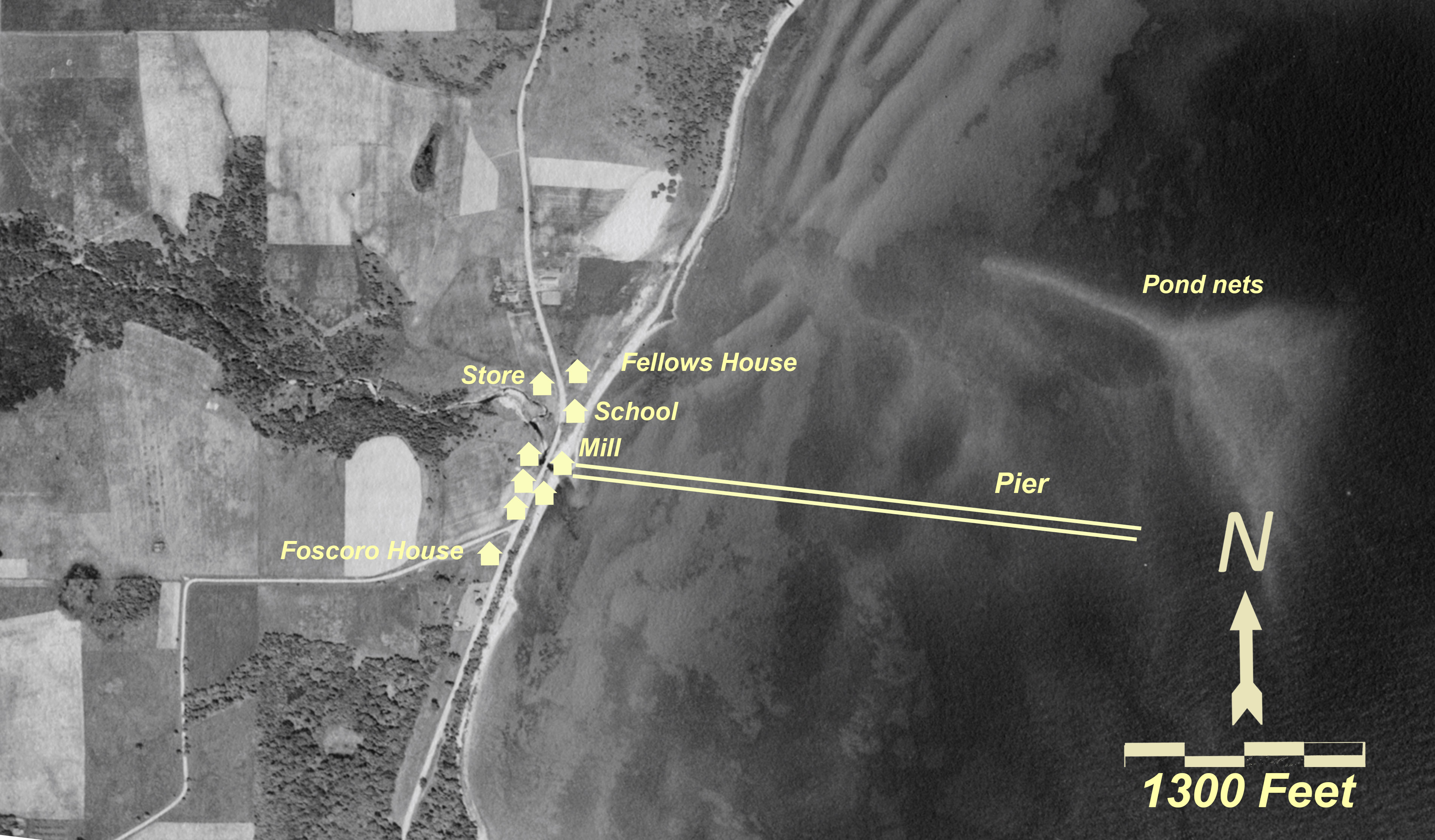
Possible Foscoro Pier layout, overlaid on a 1938 aerial image
img
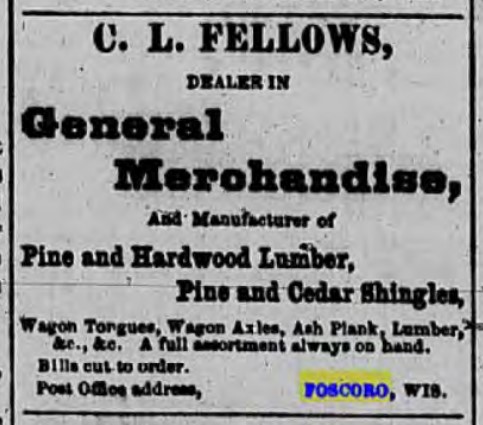
1878 newspaper advertisement for Fellows' timber products at Foscoro from 8 August 1878 issue of "Ahnapee Record"
 
Attraction
Description
Foscoro Pier, or Fellows Pier, was located in Kewaunee County about six miles north of Algoma, just south of the county line between Door and Kewaunee Counties. The community of Foscoro was founded by three individuals connected by marriage - George Warren Foster, Harvey Leicester Coe, and George Augustus Rowe. Like many of Wisconsin's ghost ports, Foscoro specialized in shipments of timber and lumber.

Orman and Ruth Jane Coe, residents of Port Washington, had three children in the 1830s to 1840s, including Mary Elizabeth Coe, Harvey Leicester Coe, and Amelia Sophia Coe. George Warren Foster, who emigrated to Wisconsin from New York in 1845, married Mary Elizabeth Coe in 1849. Harvey Leicester Coe was thirteen when his older sister married Foster. He completed his education, worked for a time as a surveyor, and then joined his brother-in-law as a junior partner in Foster's law firm. In 1866, Orman Coe bought land around the mouth of Stoney Creek in Kewaunee County. In 1869, George Augustus Rowe of Chicago married Amelia Sophia Coe. Soon after, the partnership of Foster, the younger Coe, and Rowe was formed. The three men decided to establish a community at Stoney Creek and name it after themselves - Foster-Coe-Rowe (Foscoro).

Rowe became the on-site manager of Foscoro while Foster and Coe tended to matters in Port Washington. By 1870, construction of a mill on Stoney Creek had begun and timbers were being stockpiled for construction of a pier. In early summer of 1870, the mill was in operation, work on the pier had begun, and the trio were planning construction of a grist mill and pier store. By early 1871, the pier extended 1,000 feet into Lake Michigan and Norwegian immigrants began to settle in the area. The first year of operation was a banner one. Nearly 27,000 cedar posts, over 16,000 ties, more than 2,400 telegraph poles, some 1,100 cords of bark, and 744 cords of wood were loaded on the long pier and shipped south to Chicago and Milwaukee. Somehow, the community escaped the devastations of the fall 1871 fires that ravaged Chicago, Peshtigo, and many communities in northeastern Wisconsin.

In 1872, Foster, Coe, and Rowe sold out to ship captain and former Stoney Creek fisherman, Charles Lewis Fellows. Fellows arrived in Racine from the east coast in 1834, when he was only seven years old. He ran away from home and became a cabin boy on the brig Alleghany and then rose up in the lumber fleet, becoming a ship captain, part-owner of the schooner Julia Ann, and owner of the schooner Whirlwind. Just as Fellows bought the Foscoro complex, a panic rippled through the American economy and Fellows’ financial health took a sudden turn.

Fellows' mill manager, Hugh Acker, established a shingle mill at Foscoro not long after Fellows purchased the business. Acker then resigned as manager to open Foscoro House, a combination hotel, dance hall, and saloon. By 1874, Fellows must have realized that he could not manage the property on his own. He attempted to sell, but found no buyers. In 1875, fishermen began setting up pound nets offshore of Foscoro and harvesting the area's abundant fish. Forestry products - including cedar posts, railroad ties, cordwood, tanning bark, lumber, shingles, poles, and slab wood - continued to flow out of Foscoro to Milwaukee, Racine, and Chicago. Some were shipped on Fellows's new scow Crazy Horse, which was built by local fisherman, Captain Henry Harkins.

From the 1870s to the early 1890s, Foscoro continued to ship out timber products and the Fellows family remained associated with the pier. But as with so many of Wisconsin's ghost ports, timber stocks diminished and pier shipping ceased. Several Fellows descendants continued to work and farm around Foscoro through the early 1930s, but the community itself vanished into the Wisconsin hinterlands from which it had once risen.


The latitude/longitude coordinates listed above will take you to the presumed location of Foscoro/Fellows Pier. No traces of Foscoro Pier have been located to date, but the pier likely stretched east or southeast into Lake Michigan from the shore near the modern intersection of Kennedy Drive and County Road U in Ahnapee Township, Kewaunee County. If you find evidence of the pier, please take a photograph, get coordinates (latitude and longitude preferred, but other coordinate systems work too), and email the Office of the State Archaeologist at statearchaeologist@wisconsinhistory.org.
 
Map
 
Nearby
© 2026 - Wisconsin Sea Grant, Wisconsin Historical Society